
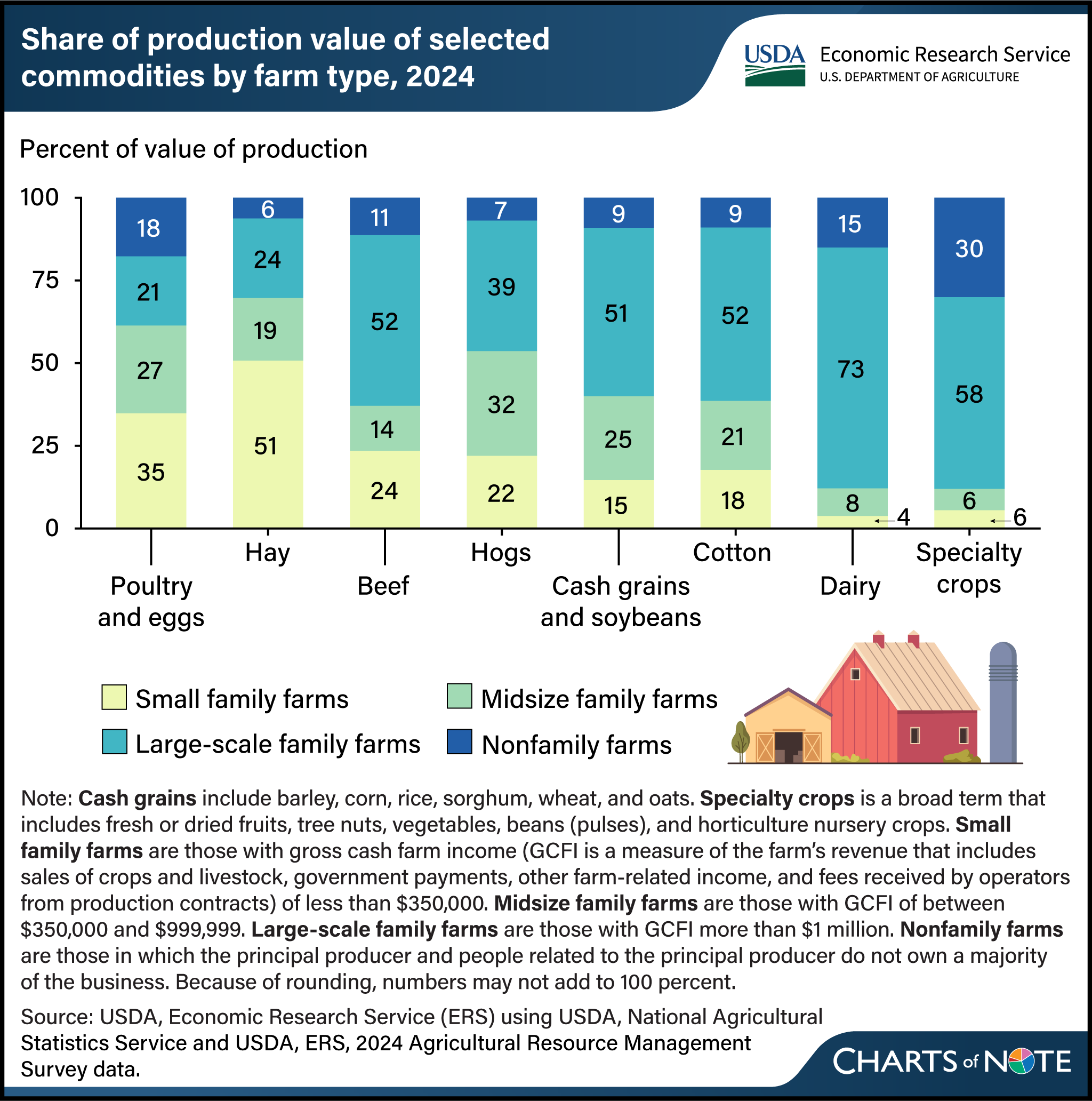
Large-scale family farms produced the majority of the value in most major American commodity groups in 2024, according to USDA's Economic Research Service — but not in all of them, and the exceptions say as much as the rule.
Their strongest position is in dairy, where they accounted for 73 percent of production value. They also produced 58 percent of the value of specialty crops, 52 percent of cotton, 52 percent of beef and 51 percent of cash grains and soybeans. ERS links that dominance to economies of scale, which tell most heavily in sectors that are high-value, high-acreage or capital-intensive.
Small family farms held their ground where scale counts for less. They produced 51 percent of the value of hay and 35 percent of poultry and eggs — sectors where smaller acreage or production under contract is more common.
Midsize family farms sat between the two, contributing between 6 and 32 percent of production value across the commodity groups. They were strongest in hogs at 32 percent, poultry and eggs at 27 percent, and cash grains and soybeans at 25 percent.
Nonfamily farms were most visible in specialty crops, where they accounted for 30 percent of production value — their highest share in any commodity category.
Year on year the shares moved. Compared with 2023, large-scale family farms expanded their role in poultry and egg production but lost ground in cotton, where midsize farms gained. Nonfamily farms reduced their share of both cattle and hog production.
The pattern is worth noting wherever farm consolidation is debated: even in the most consolidated large agriculture in the world, the family farm remains the unit of production. What has changed is the size of the family farm, not the ownership model. The chart appears in the ERS report America's Farms and Ranches at a Glance, published in February 2026 by Katherine Lacy and Katherine Lim.
Source: USDA Economic Research Service

Comments
(0)