
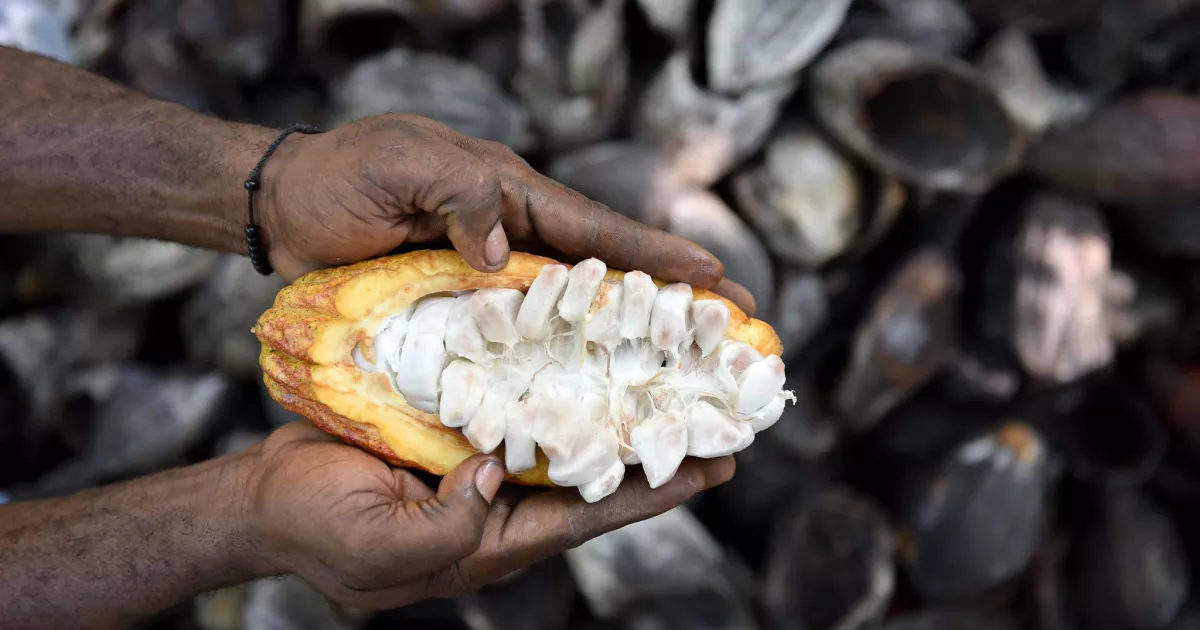
Carbon credits are routinely offered as the way to pay for a farmer's move into agroforestry: the trees store carbon, the farmer earns from it, and the sums work out. Research on Colombia's cacao sector finds that the numbers do not come close.
Ibukun Taiwo, Martha Vanegas and Carlos Andres Borda examined whether carbon revenue could cover the cost of switching cacao farms in Caquetá and César to agroforestry, comparing basic, intermediate and advanced systems in a paper now under review. All three produced a positive net present value over 25 years in both regions. Cacao agroforestry is profitable in the long run.
It is the short run that defeats farmers. Cacao yields nothing in the first two years, income is depressed for roughly seven, and the largest returns — particularly from timber — may not arrive until year 20 or later. The farmer pays for establishment and upkeep long before the system pays back. Of 927 cacao farmers surveyed across 28 municipalities in the two departments, about 70 per cent had no access to a loan, despite having applied for finance to plant and to buy inputs.
Against that gap, the carbon revenue is small. In Caquetá — the more favourable of the two — credits raised the net present value of the advanced agroforestry system by roughly USD 180 a hectare across 25 years, assuming the 2022 carbon price of USD 4.59 per tonne of CO₂ equivalent used in Colombia's carbon-tax exemption scheme and a 25-year crediting period, with validation, verification and certification costs taken from national reference figures.
In César the result reversed. The tree species in those systems capture less carbon, and once registration and transaction costs were counted, credits lowered profitability by about USD 17 a hectare. Two regions of the same country, one modestly helped and one slightly harmed, is the clearest possible argument that carbon-finance projections have to be built on local species, sequestration rates, prices, project scale and transaction costs rather than a national average.
There is a further barrier in Caquetá and César, both post-conflict departments. Taking part in carbon markets, or in Colombia's Obras por Impuestos mechanism, requires a legally recognised claim to the land. Under Decree Law 870 of 2017 that means being an owner, a legally recognised possessor, or a good-faith occupant with a purchase agreement. A farmer who cannot show one of those is excluded, however willing they are to plant.
The authors are not arguing that carbon markets are useless — only that they are a supplement, not a foundation. What farmers need is money at the start: establishment grants, targeted subsidies and affordable long-term credit. Obras por Impuestos, which lets companies direct part of their income tax to approved projects in conflict-affected municipalities, can pay for nursery propagation, planting, technical assistance and cash to smallholders during the years when nothing is coming in. Carbon income can then follow, once the trees are mature and verification is met.
Source: CGIAR


Comments
(0)